From workplace to living space
The workplace is in constant transformation. And it is no longer driven by new technologies or added functions, but by a shift in what we expect a place to be.
After years of efficiency, optimisation and standardisation, we are seeing a movement away from performance – towards presence. The office is shifting from a place of output to an environment for a sustainable human rhythm.
Human resonance
For some time now, workplaces have borrowed from hospitality. We see this reflected in many of the projects being highlighted today – but now with a different intention.
Spaces are created to balance focus and recovery, activity and stillness, the individual and the collective. Materials are softer. Lighting more responsive. Acoustics more considered. We move beyond creating a “nicer” workplace towards supporting the natural rhythm of people.
Care as structure
Lounges, café areas, sensory environments and social zones have become an integral part of the workplace. In projects such as SPREAD in Berlin by ROH Architects or Second Home av Selgas Cano the boundary between workplace and social environment dissolves. Movement, meetings and recovery are integrated into a coherent spatial experience.
Yet within this lies a tension. When everything is provided – food, exercise, rest – where is the line between care and control? When does flexibility become an expectation to always be available? The most relevant workplaces today are not those that offer the most, but those that understand how to set boundaries. Care is about creating space.
Visible values
At the same time, another shift is taking place. Sustainability has moved from strategy documents into architecture. In projects such as The Future Ruin by Yatofu Creatives
material choices and construction become part of the narrative. What was once hidden – structures, layers, history – is revealed.
Sustainability is not only practised – it is visible. Reuse, circular systems and local materials become carriers of identity. The space communicates what the organisation stands for, without having to say it.
From norm to spectrum
One of the most fundamental changes concerns who we design for. The traditional workplace has long been based on the idea of a “standard user” – a model that is now dissolving.
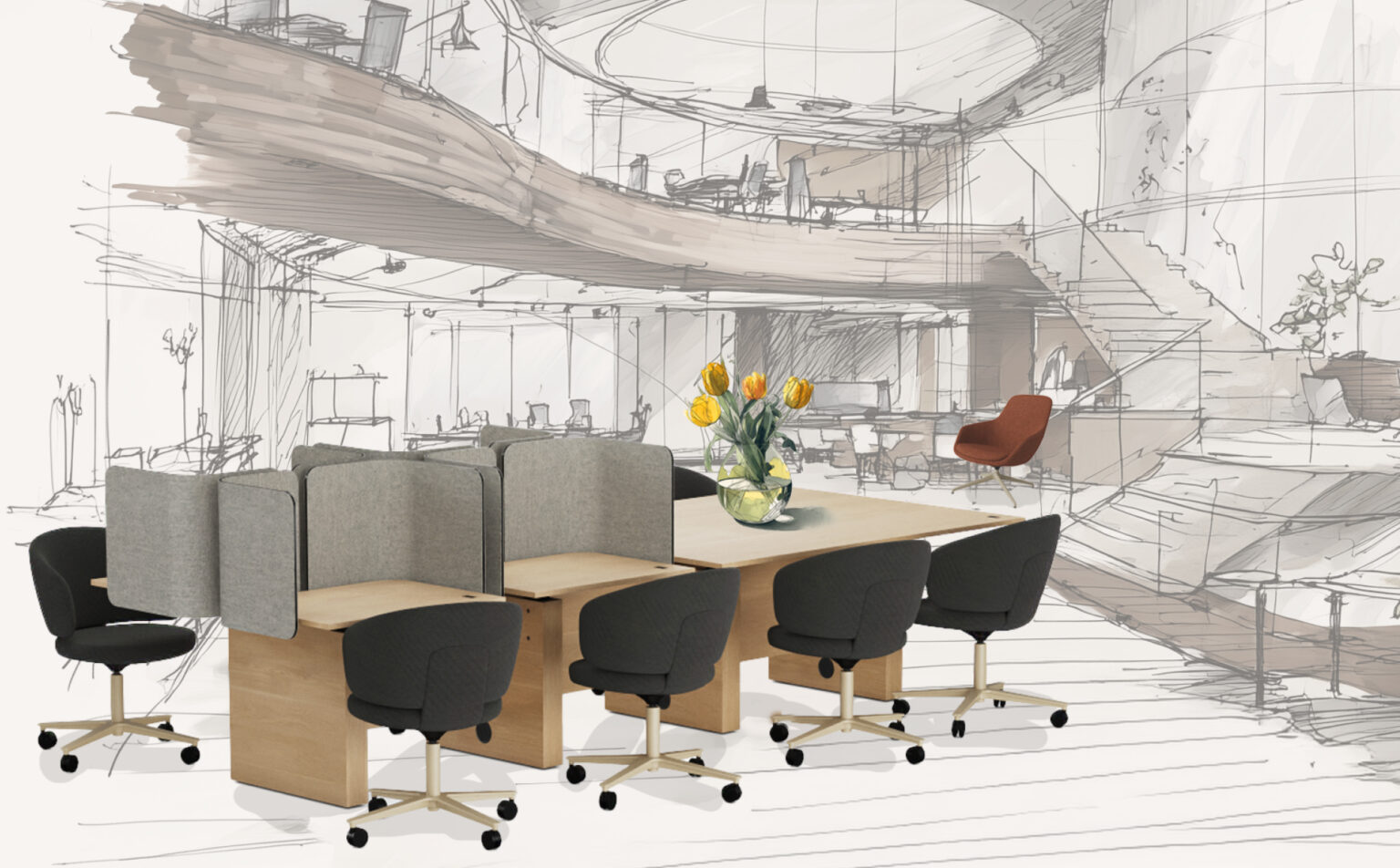
In what is described as the Desk Spectrum, environments are instead shaped around variation: quiet zones for concentration, social areas for interaction, and both low- and high-stimulus settings. Light, sound, materials and spatial composition are actively used to support different cognitive states.
A redefinition of function. Good design is no longer about working for most people – but for as many as possible, in different ways.
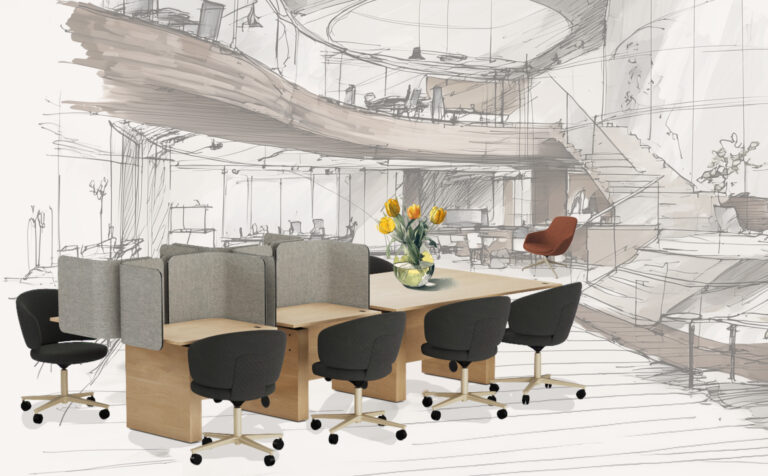
In Horreds’ solutions, such as Nomono Compact, individual workstations are combined with coworking areas. This creates flexibility in the space – but more importantly, it adapts to people’s different needs.
Authenticity in a filtered world
At the same time, a counter-movement is emerging against the perfect, polished and generic. In a time where AI can generate endless variations of the same expression, the value of what feels real increases. The tactile. The local. That which carries traces of time and hand.
Projects such as Colab av Lucas Muñoz Muñoz show how reuse and raw materiality can become an aesthetic position – not a compromise. The notion of luxury is shifting. Not excess, but care, quality and longevity. Choosing fewer objects – but better. Creating environments that last, both physically and emotionally.
For us at Horreds, this has always been a starting point. In the Levels Meeting Table we work with layers and dimensions in space. In Anne, a classic form is developed for new contexts. In the quilted Glove Lounge a tactile quality enhances the experience.
The evolving role of work
Perhaps the most interesting shift is that the workplace is no longer seen as a destination, but as a prototype. A testing ground for how we want to live, collaborate and feel in the future. New ways of organising time, relationships and space are explored here. Cultures are built – not just workflows.
And in that movement, interior design and architecture become tools to attract, create belonging and build brand over time. In a world where we can work from anywhere, we choose to go to places that give something back.
If you would like to learn more about our perspective on truly sustainable design, you are welcome to get in touch.
Sources: Frame, lovethatdesign.com, Second Home.