
In today’s workplace development, we see a clear shift: from driving pure productivity to supporting people’s health and life balance. We have identified three insights based on current trends and emerging behaviours.
Wellbeing before luxury
People choose a workplace much like they choose a brand. Attractiveness is less about perks and more about environments that affirm identity, culture and human needs.
“Hotelification” is a strong force in workplace design, aiming to create more inviting, welcoming contexts. But the fundamentals of true wellbeing have to be there first. Light, air, acoustics, temperature and a sense of safety are the baseline.
At the same time, while hotelification clearly shows that people enjoy being at the office more, studies also point to a risk: it can blur the boundaries between work and private life. As a result, focus is shifting towards wellbeing and sustainable work–life rhythms, not just efficiency.
WELL certification marks this shift through a clear people-first commitment, where the building is expected to support both physical and mental health. More about WELL
Recovery vs stress triggers
Sensory design and neuroscience show that spaces are never neutral – they either support the nervous system or trigger stress. In digitally intense environments where burnout is on the rise, this becomes a critical design question. Constant connectivity simultaneously disconnects us from ourselves, from others and from natural rhythms.
As a counter-movement, the demand for environments that offer real presence is growing. Authentic materials, physical encounters and moments without connectivity. One example is The Offline Club, created for device-free, shared time together in analogue spaces.
Ramy Elnagar, Strategic Partner at White Mirror, sums it up: “Your nervous system isn’t a machine – it’s an ecosystem. It needs rhythm, restoration and room to breathe.”
White Mirror develops immersive environments where sound, light and natural processes function as experience as medicine – for instance the Lupuna forest bathing experience.
The workplace as a living, open, cultural and adaptive ecosystem
Future workplaces are moving away from closed office blocks towards open urban ecosystems. Ground floors are activated with coworking, public programming and community areas that strengthen the relationship between building, tenants and neighbourhood.
In parallel, architecture and spatial storytelling are used to express identity and culture. Naming meeting rooms “Apartments”, “Winter Garden” or “Library” creates the sense of entering a coherent narrative rather than just a functional building.
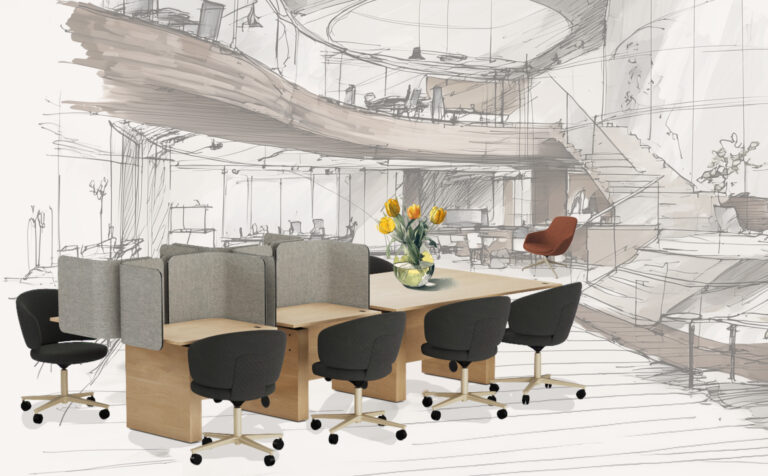
Flexibility has become a core principle. Spaces and furniture need to shift between focus, social interaction and events – without rebuilding. Modular systems and adaptive architecture are therefore seen as long-term, sustainable investments rather than compromises.
Horreds as an ecosystem
For us, Horreds is never just a delivery of furniture. Here, we literally place our hands on tactile surfaces for that final touch. We strengthen our teams and together build a local, sustainable ecosystem – where almost everything is manufactured on site in the village of Horred.
VX Personal Storage creates green islands that also function as cabinets, dividers or even a social staircase in the middle of the space. A-Frame, Nomono Compact and Log are examples of furniture that enable flexible and supportive workplaces where authenticity and presence can be felt. Environments which – in our view – genuinely support health and wellbeing.
Would you like to see and experience the Horreds collections up close? We’re happy to welcome you to a tour of our factory – or book a viewing in one of our showrooms.